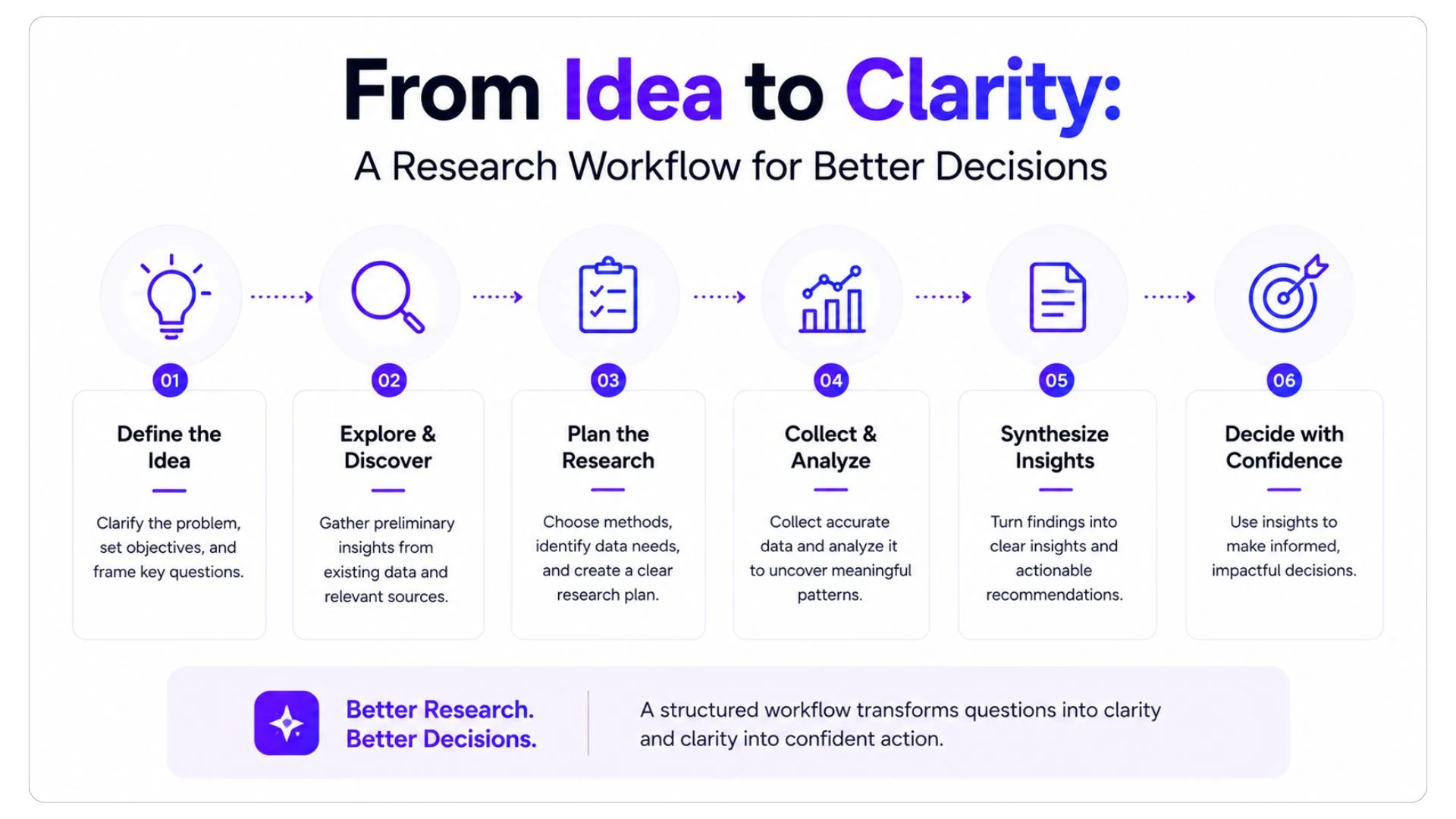

Information has never been easier to access. AI tools can generate ideas, answer questions, summarize reports, and help explore opportunities within minutes. Yet many people still struggle to make decisions because information alone doesn’t create clarity. In this article, we’ll explore a practical research workflow that helps turn ideas, research, and scattered information into clearer business decisions using a combination of AI tools, trusted sources, and human judgment.
You have an idea, a question, a problem to solve, or a decision to make. Naturally, the first step is research. Today, that’s easier than ever. Within minutes, you can ask AI tools, search Google, watch videos, read articles, explore discussions, and collect information from countless sources. Yet despite having access to more information than ever before, many people still struggle to move forward with confidence.
The reason is simple: information and clarity are not the same thing. Information is easy to collect. Clarity takes structure, validation, and understanding. This article explores a practical research workflow designed to help turn scattered information into clearer business decisions.
What We'll Cover
In this article, we’ll explore a practical research workflow for turning ideas and questions into clearer business decisions. We’ll discuss the difference between information and clarity, how to research more effectively, where AI tools fit into the process, how to organize findings, avoid common research mistakes, and use research to make better-informed decisions.
The Information Abundance Problem
Information is no longer difficult to find. The real challenge is dealing with the overwhelming amount of it. This section explores how information abundance can create confusion, why access alone is no longer an advantage, and why effective research requires filtering, organizing, and understanding information rather than simply collecting it.
Information Has Become Abundant
Finding information is no longer difficult. Whether you’re exploring a business idea, researching an industry, or trying to understand a market, information is available almost everywhere. Search engines, industry reports, communities, videos, and AI tools can provide answers within minutes. The barrier is no longer access. Most people can find information whenever they need it.
Access Is No Longer the Advantage
Because information is widely available, simply having access to it no longer creates an advantage. Two people can read the same reports, use the same AI tools, and visit the same websites, yet reach completely different conclusions. The difference is rarely the amount of information they have. The difference is how they evaluate and use it.
The Cost of Unlimited Information
More information creates more choices. More choices create more possibilities. But they also create more uncertainty. Every source introduces a new perspective, a new recommendation, or a different interpretation. Instead of helping people move faster, excessive information often makes it harder to decide what actually matters.
Why Research Feels Harder Than Ever
Research feels difficult today not because information is unavailable, but because information never stops. There is always another article to read, another video to watch, another report to download, and another AI response to generate. Without a process, research can easily become continuous consumption rather than meaningful understanding.
The Real Problem
The biggest challenge in modern research is not finding answers. It is deciding which answers deserve attention. Information is abundant. Attention is limited. That is why effective research is not about collecting more information—it’s about identifying what is relevant, filtering out what isn’t, and turning information into clarity.
Information, Knowledge, Understanding, and Clarity Are Not the Same Thing
Collecting information is only the beginning of research. To make better decisions, information must be transformed into knowledge, understanding, and ultimately clarity. This section explains the difference between these stages and why true research is less about gathering facts and more about making sense of them.
Information Is the Raw Material
Most research starts with information. It can come from articles, reports, videos, industry studies, customer feedback, AI-generated responses, or conversations with other people. Information gives us facts, data points, opinions, observations, and possibilities. On its own, however, information does not tell us what to do. It simply provides inputs that need further examination.
Knowledge Comes From Organization
Information starts becoming knowledge when it is organized and connected. Instead of looking at isolated facts, patterns begin to appear. You start understanding how different pieces of information relate to each other. Knowledge is not about having more data; it is about creating structure from the data you already have.
Understanding Comes From Interpretation
Knowledge alone is still not enough. Two people can possess the same knowledge and reach completely different conclusions. Understanding develops when you begin interpreting information within a specific context. You identify patterns, recognize relationships, evaluate trade-offs, and understand why certain things happen. This is the stage where research starts becoming useful rather than simply informative.
Clarity Comes From Relevance
Clarity is different from information, knowledge, and understanding. It is the point where the noise starts disappearing and what matters becomes easier to see. Clarity does not mean knowing everything. It means knowing enough to make a decision, choose a direction, or take the next step with confidence. Many people keep researching because they believe more information will create clarity. In reality, clarity usually comes from processing information, not collecting more of it.
The Real Goal of Research
Many people treat research as a process of gathering information. In reality, information collection is only the starting point. The value of research emerges when information turns into knowledge, knowledge develops into understanding, and understanding leads to clarity. That is when research begins to support better decisions instead of simply creating larger collections of notes, links, and documents.
Stage One: Exploring Possibilities
Every research process starts with uncertainty. At this stage, the goal is not to find the perfect answer or validate a predetermined idea. The goal is to explore possibilities, ask better questions, and understand what deserves further investigation. Strong research begins with curiosity and open-mindedness, not conclusions.
Start With Questions, Not Answers
One of the most common mistakes people make is starting research with a conclusion already in mind. They become attached to a specific idea and then look for information that supports it. Effective research works differently. Instead of searching for confirmation, it starts with questions. What problem exists? Who experiences it? Is there demand for a solution? What alternatives already exist? Questions create exploration, while assumptions often limit it.
Explore Beyond the First Idea
The first idea that comes to mind is not always the best opportunity. Sometimes a simple business idea can lead to a better service opportunity. A service opportunity can reveal a market gap. A market gap can uncover an entirely different direction worth pursuing. Research becomes more valuable when multiple possibilities are explored before committing time, money, and resources to a single path.
Challenge What You Think You Know
At the beginning of any research process, most conclusions are assumptions. An industry may appear attractive from the outside. A market may seem underserved. A problem may look important. However, assumptions are not evidence. Exploring possibilities requires a willingness to challenge existing beliefs and test whether initial impressions match reality.
Expand the Range of Possibilities
This stage is not about making decisions. It is about increasing awareness of what is possible. Whether you’re evaluating a business idea, considering a new service, entering a market, or looking for growth opportunities, the objective is to understand the landscape before narrowing your focus. The wider your perspective at this stage, the stronger your decisions will be later.
The Goal of Exploration
Exploration is not meant to produce certainty. It is meant to create direction. By asking better questions, considering multiple possibilities, and challenging assumptions, you create a stronger foundation for the research that follows. Good research rarely starts with answers. It starts with curiosity.
Stage Two: Validating Assumptions
Ideas are easy to create. Evidence is harder to find. This stage focuses on testing assumptions against reality. Instead of asking whether an idea sounds good, the goal is to understand whether there is enough evidence to support it through market signals, industry data, competitor activity, and real-world demand.
Every Idea Starts as an Assumption
At the beginning of the research process, most ideas are based on observations, experiences, opinions, or intuition. You might believe there is demand for a product, a gap in the market, or an opportunity worth pursuing. There is nothing wrong with these assumptions—they are often where great ideas begin. The problem arises when assumptions are treated as facts before they have been tested.
Look Beyond Opinions
The internet is full of opinions. Experts share them, creators share them, communities share them, and AI tools can generate even more of them. While opinions can provide useful perspectives, they should not be confused with evidence. Effective research requires looking beyond what people think and examining what the available data, trends, and market signals actually suggest.
Study the Industry and Market
Before committing to any direction, it is important to understand the environment in which that idea will exist. Industry research helps identify trends, challenges, regulations, and opportunities. Market research helps uncover customer needs, demand patterns, and competitive conditions. Together, they provide context that is difficult to gain from assumptions alone.
Learn From Existing Competitors
Competitor research is often one of the fastest ways to understand a market. Existing businesses can reveal what customers value, how services are positioned, what problems are being solved, and where potential gaps may exist. The goal is not to copy competitors but to understand the landscape you are entering.
Collect Reliable Sources
Good decisions require reliable information. Reports, industry publications, company websites, case studies, surveys, customer feedback, and trusted data sources provide stronger foundations than isolated opinions. As research progresses, collecting and organizing these sources becomes increasingly important because they will support future analysis and decision-making.
The Goal of Validation
An idea does not become stronger simply because more people agree with it. It becomes stronger when evidence supports it. Validation is the process of moving from possibilities to probabilities. Instead of asking, “Do I like this idea?” the question becomes, “What evidence suggests this idea deserves further attention?” This shift is what transforms research from speculation into informed decision-making.
Stage Three: Building a Research Hub
Research becomes difficult to manage when information is scattered across browser tabs, bookmarks, documents, notes, screenshots, and AI conversations. This stage focuses on creating a central place where research can be stored, organized, and connected. The goal is not to collect more information, but to make existing information easier to understand and use.
Research Often Becomes Scattered
Most people don’t lose information because they fail to find it. They lose it because it ends up scattered across multiple places. A useful article gets bookmarked. An important report is downloaded and forgotten. Notes are stored in different apps. AI conversations contain valuable insights that are never revisited. Over time, research becomes fragmented, making it difficult to see the bigger picture.
Saved Links Are Not a Research System
Collecting information and organizing information are two different activities. A folder full of bookmarks, PDFs, and screenshots may contain valuable information, but it does not automatically create understanding. When information exists in isolation, it becomes harder to compare findings, identify patterns, and revisit important insights later.
Create a Central Place for Research
As research grows, having a central location for documents, notes, reports, findings, and references becomes increasingly important. This doesn’t have to be complicated. The objective is simply to ensure that information related to a specific topic can be accessed, reviewed, and connected without constantly searching for where it was originally found.
Connect Information Across Sources
The real value of research appears when information from different sources starts connecting with each other. A market report may support a trend identified during competitor research. Customer feedback may explain patterns found in industry data. Insights that seem unrelated at first often become meaningful when viewed together. This is difficult to achieve when information remains scattered.
Where Research Hubs Become Useful
This is where dedicated research and knowledge management tools become valuable. Instead of treating every document, report, or note as a separate piece of information, research hubs help organize them into a connected system. Tools such as NotebookLM are useful not because they generate answers, but because they help bring multiple sources into one place, making it easier to explore relationships, identify patterns, and deepen understanding.
The Goal of a Research Hub
A research hub is not about storing more information. It is about reducing friction during the research process. When information is organized, accessible, and connected, less time is spent searching and more time is spent understanding. Research becomes significantly more valuable when information works together instead of existing in isolation.
Stage Four: Turning Information Into Understanding
Collecting information is only part of the research process. Real value emerges when information is analyzed, compared, and interpreted. This stage focuses on turning research findings into meaningful understanding by identifying patterns, opportunities, risks, and insights that support better decision-making.
Information Alone Doesn't Create Insight
By this stage, you may have reports, notes, competitor research, market data, articles, and AI-generated findings. However, simply possessing information does not automatically make it useful. Understanding develops when information is examined as a whole rather than as individual pieces.
Look for Patterns, Not Individual Facts
A single source can be interesting, but multiple sources pointing toward the same conclusion are often more valuable. As research progresses, recurring themes, common challenges, market trends, customer needs, and competitor behaviors begin to appear. These patterns often reveal more than any single article, report, or opinion.
Separate Signal From Noise
Not every finding deserves equal attention. Some information may be outdated, biased, irrelevant, or disconnected from the original objective. Effective research requires identifying which insights genuinely matter and which are simply distractions. This process helps reduce noise and focus attention on information that can influence decisions.
The Goal of Understanding
The purpose of this stage is not to collect more information. It is to make sense of the information already available. Research starts creating value when patterns become visible, opportunities become clearer, risks become easier to identify, and the bigger picture begins to emerge. Understanding comes from analysis, not accumulation.
Stage Five: Returning to Strategic Thinking
Research is valuable only when it helps create direction. After gathering, validating, organizing, and analyzing information, the next step is deciding what to do with it. This stage focuses on using research to evaluate options, prioritize opportunities, and make more informed decisions.
Research Should Create Direction
The purpose of research is not to collect information forever. At some point, research must lead to action. Whether you’re evaluating a business idea, entering a market, launching a service, or planning future growth, research should help narrow possibilities and make the next step clearer.
Evaluate Options and Trade-Offs
Every opportunity comes with advantages, limitations, risks, and costs. Research helps bring these factors into view. Instead of making decisions based on assumptions or opinions, you can evaluate options using evidence, context, and a better understanding of the situation. The goal is not to find a perfect option, but to identify the most reasonable one based on the information available.
Research Supports Decisions, It Doesn't Make Them
This is where many people get stuck. They keep researching because they want complete certainty before moving forward. In reality, no amount of research can remove all uncertainty. Research can improve decision quality, reduce unnecessary risks, and provide direction, but the final decision still requires human judgment. The goal is not to know everything. The goal is to know enough to move forward with confidence.
Where AI Fits Into Modern Research
AI has changed how research is performed, but it has not changed the purpose of research itself. Instead of replacing the research process, AI can support different stages of it—from exploration and validation to organization and strategic thinking. The key is understanding where each tool fits and what role it should play.
AI Is a Tool, Not the Process
One of the biggest misconceptions about AI is that it can replace research. In reality, AI works best when it becomes part of a research workflow rather than the workflow itself. It can help generate ideas, summarize information, organize findings, and support analysis, but it still depends on the quality of the questions, sources, and information provided.
Exploration: Expanding Possibilities
At the beginning of the research process, AI can help explore ideas, generate questions, identify angles worth investigating, and expand thinking beyond initial assumptions. Instead of looking for final answers, this stage is about discovering possibilities and identifying areas that deserve deeper research.
Validation: Supporting Research
As research progresses, AI can assist with market exploration, industry research, source discovery, and information gathering. It can help identify trends, summarize findings, and surface relevant resources. However, the responsibility for validating sources and verifying claims still belongs to the researcher.
Knowledge: Organizing and Connecting Information
AI becomes particularly useful when dealing with large amounts of information. Research documents, reports, notes, transcripts, and findings can be organized, summarized, and connected more efficiently. This helps reduce the time spent managing information and increases the time available for analysis and understanding.
Strategy: Refining Decisions
Once research has been completed, AI can help structure ideas, evaluate options, create frameworks, and facilitate strategic discussions. It can support decision-making by presenting perspectives and organizing thinking, but it cannot replace context, experience, judgment, or accountability.
The Right Way to Think About AI
The most effective use of AI is not asking it to replace research. It is using it to make research more efficient, organized, and productive. AI works best when it supports a structured research process, not when it becomes a substitute for one.
Common Research Mistakes
Research is meant to improve decision-making, but certain habits can have the opposite effect. Many people spend significant time researching yet make little progress because they fall into common traps that create confusion, delay action, and weaken the quality of their conclusions.
Researching Without Making Decisions
One of the most common mistakes is treating research as an endless activity. New articles, reports, videos, and AI responses continue to appear, making it easy to keep researching without ever deciding what to do next. Research should support decisions, not delay them indefinitely.
Trusting a Single Source
No source has a complete picture. Articles, experts, reports, communities, and AI tools all have limitations. Relying too heavily on a single source increases the risk of bias and incomplete understanding. Strong research is built by comparing multiple perspectives and looking for consistency across sources.
Confusing Summaries With Understanding
A summary can save time, but it does not automatically create understanding. Understanding develops when information is analyzed, questioned, compared, and interpreted within context. Reading a summary may explain what was said, but not necessarily what it means.
Collecting Information Without Organizing It
Many researchers spend considerable effort gathering information but very little effort managing it. Valuable insights become difficult to revisit when they are scattered across notes, bookmarks, documents, screenshots, and AI conversations. Organized research is often more useful than larger amounts of unorganized research.
Seeking Certainty Instead of Clarity
Research can reduce uncertainty, but it cannot eliminate it. Many people continue searching for one more source, one more report, or one more opinion in the hope of finding complete certainty. In reality, good decisions are usually made with sufficient understanding, not perfect information.
Using AI Outputs Without Validation
AI can accelerate research, but its outputs should not be treated as unquestionable facts. AI-generated information may be incomplete, outdated, or incorrect. Important findings should be verified using reliable sources before they influence significant decisions.
Using AI Outputs Without Validation
AI can accelerate research, but its outputs should not be treated as unquestionable facts. AI-generated information may be incomplete, outdated, or incorrect. Important findings should be verified using reliable sources before they influence significant decisions.
The Goal Is Progress, Not Perfection
Research becomes valuable when it creates understanding and supports action. The objective is not to know everything or eliminate every uncertainty. The objective is to reduce confusion, improve confidence, and move closer to a well-informed decision.
Better Decisions Start With Better Research
Research is not about finding perfect answers. It is about reducing uncertainty, improving understanding, and creating enough clarity to make better decisions. The businesses and professionals who consistently make better decisions are often not the ones with the most information, but the ones with the most effective research process.
Research Reduces Uncertainty
Every important decision involves some level of uncertainty. Whether you’re evaluating a business idea, entering a new market, launching a service, or planning future growth, there will always be things you don’t know. The purpose of research is not to eliminate uncertainty completely. It is to reduce it enough that decisions can be made with greater confidence and fewer assumptions.
A Process Creates Better Outcomes
Many people approach research differently every time a new question appears. Sometimes they rely on opinions, sometimes on AI, and sometimes on random articles they find online. A structured process creates consistency. It ensures that ideas are explored, assumptions are validated, information is organized, and findings are properly evaluated before decisions are made.
AI Can Assist, But Judgment Still Matters
Modern AI tools have made research faster and more accessible than ever. They can help generate ideas, discover information, organize findings, and support analysis. However, AI does not understand context the way humans do. It cannot take responsibility for outcomes, evaluate every real-world variable, or make decisions on your behalf. That responsibility still belongs to the person conducting the research.
Build a Repeatable Research System
The value of a good research process extends far beyond a single project or decision. Once a repeatable system is in place, it can be applied to new business ideas, market opportunities, strategic decisions, content planning, competitive analysis, and countless other situations. Over time, the system becomes more valuable than any individual piece of information collected along the way.
Build a Repeatable Research System
The value of a good research process extends far beyond a single project or decision. Once a repeatable system is in place, it can be applied to new business ideas, market opportunities, strategic decisions, content planning, competitive analysis, and countless other situations. Over time, the system becomes more valuable than any individual piece of information collected along the way.
The Real Goal
The goal of research is not to know everything. The goal is to understand enough to make a better decision than you could have made before the research began. Because in the end, better decisions rarely come from having more information. They come from understanding the right information.
Conclusion
Before we wrap up, one quick note. This article is longer than usual because the goal was to explain the research process properly, not increase the word count. Some topics simply need more context to be genuinely useful.
If you don’t have time to read the entire article right now, you can copy the article link, paste it into ChatGPT, Gemini, or any AI tool you use, and ask for a summary. Then come back later and explore the sections that matter most to you.
Now, the key takeaway.
Information is no longer difficult to find. The real challenge is turning that information into clarity. Research is not about collecting more articles, reports, or AI responses. It is about understanding what matters, filtering out what doesn’t, and making better decisions with the information available.
The tools may change, but the principle remains the same: better research leads to better decisions. Because in the end, information is only the starting point.
Clarity is the destination.
Frequently Asked Questions
Because information and clarity are not the same thing. Most people spend time collecting information but very little time organizing, validating, and interpreting it. Without a process, more information often creates more confusion rather than better decisions.
Information consists of facts, opinions, data, reports, and observations. Clarity is the ability to understand what is important, what is not, and what actions should be taken next. Information is the input; clarity is the outcome.
No. AI can help generate ideas, summarize content, organize information, and support analysis, but it cannot replace human judgment. Research still requires critical thinking, source validation, context, and decision-making.
There is no single best tool. Different tools serve different purposes. Some are useful for brainstorming ideas, others for deep research, information organization, analysis, or strategic planning. The most effective approach is usually a workflow that combines multiple tools rather than relying on one.
A research hub is a centralized place where reports, notes, findings, references, and research documents are stored and organized. Its purpose is to make information easier to access, connect, and analyze rather than leaving it scattered across different platforms and files.
Research should reduce uncertainty, not eliminate it completely. Waiting for perfect information often delays progress. In most situations, the goal is to gather enough evidence and understanding to make a well-informed decision with reasonable confidence.
No. While the examples in this article focus on business decisions, the same workflow can be applied to freelancing, consulting, content creation, career planning, learning new skills, evaluating opportunities, and many other situations that require research and decision-making.
Because information becomes difficult to use when it is scattered across tabs, documents, notes, bookmarks, and conversations. Organizing research makes it easier to identify patterns, compare findings, revisit important insights, and turn information into understanding.
One of the most common mistakes is treating research as an endless activity. Many people continue collecting information long after they have enough to make a decision. Research should create direction, not become a reason to avoid action.
The goal of research is not to collect more information. The goal is to turn information into understanding and understanding into clarity. Better decisions rarely come from having more information—they come from making better sense of the information you already have.
Because information and clarity are not the same thing. Most people spend time collecting information but very little time organizing, validating, and interpreting it. Without a process, more information often creates more confusion rather than better decisions.
Information consists of facts, opinions, data, reports, and observations. Clarity is the ability to understand what is important, what is not, and what actions should be taken next. Information is the input; clarity is the outcome.
No. AI can help generate ideas, summarize content, organize information, and support analysis, but it cannot replace human judgment. Research still requires critical thinking, source validation, context, and decision-making.
There is no single best tool. Different tools serve different purposes. Some are useful for brainstorming ideas, others for deep research, information organization, analysis, or strategic planning. The most effective approach is usually a workflow that combines multiple tools rather than relying on one.
A research hub is a centralized place where reports, notes, findings, references, and research documents are stored and organized. Its purpose is to make information easier to access, connect, and analyze rather than leaving it scattered across different platforms and files.
Research should reduce uncertainty, not eliminate it completely. Waiting for perfect information often delays progress. In most situations, the goal is to gather enough evidence and understanding to make a well-informed decision with reasonable confidence.
No. While the examples in this article focus on business decisions, the same workflow can be applied to freelancing, consulting, content creation, career planning, learning new skills, evaluating opportunities, and many other situations that require research and decision-making.
Because information becomes difficult to use when it is scattered across tabs, documents, notes, bookmarks, and conversations. Organizing research makes it easier to identify patterns, compare findings, revisit important insights, and turn information into understanding.
One of the most common mistakes is treating research as an endless activity. Many people continue collecting information long after they have enough to make a decision. Research should create direction, not become a reason to avoid action.
The goal of research is not to collect more information. The goal is to turn information into understanding and understanding into clarity. Better decisions rarely come from having more information—they come from making better sense of the information you already have.